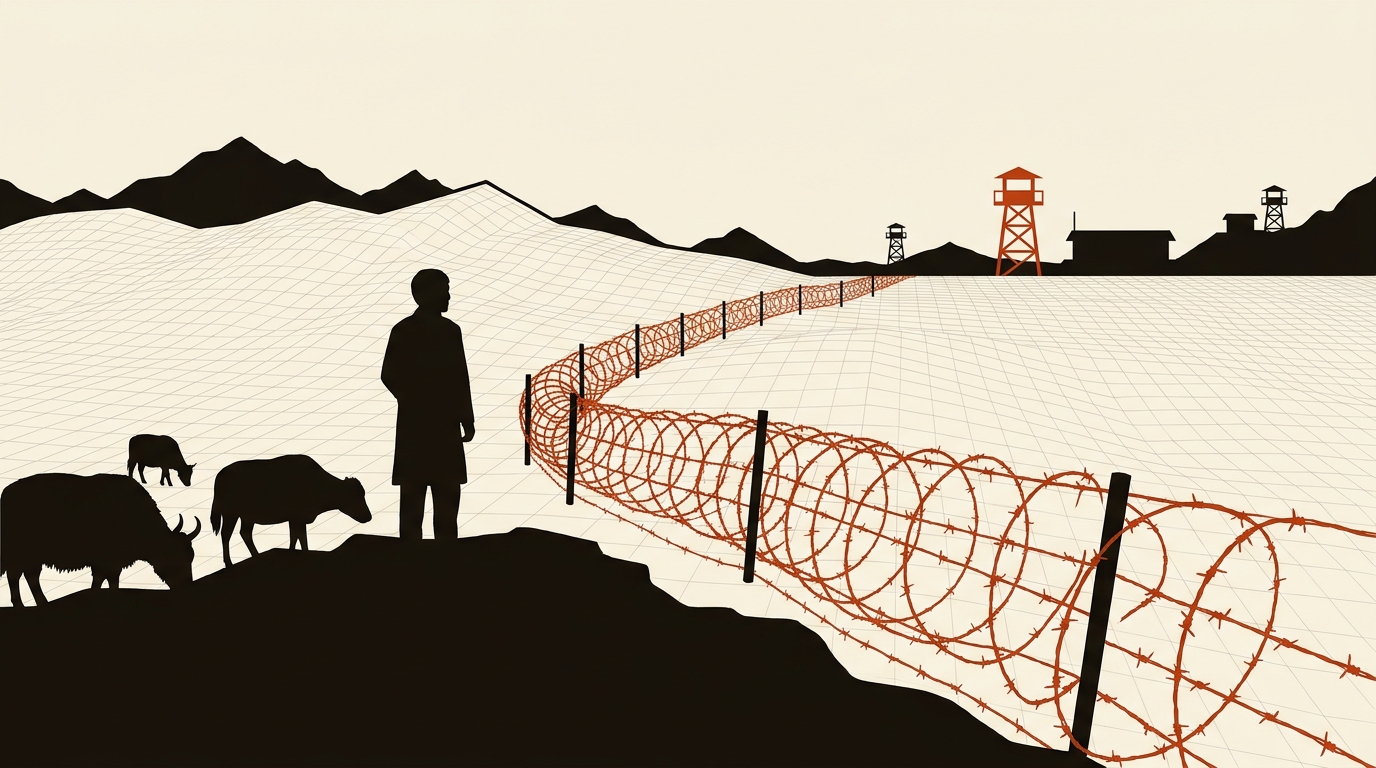
Katon Moyong: The Viral Fight Over Arunachal's Siang Dam
Katon Moyong, the "Abor Man" of the Siang valley, rejected talks with the Arunachal government. Here is what the survey, the arrests and the tribal opposition actually show.
Verdict: false alarm.

The dispute is not between India and China over a river. It is over who pays for a national security project, and whether the people who live there get a say.
Correction (2026-11-15): An earlier version of this article linked to the News9Live, The Hindu, ThePrint and Indian Express homepages, gave the project capacity as 11,000 MW, and said the reservoir would submerge more than 60 villages. The project is planned at 11,200 MW. The 60 figure is the number of traditional village councils that Katon Moyong wants involved, while the Siang Indigenous Farmers Forum puts submergence at 27 villages. Every source now points to the specific report.
Short answer: Nothing about the Siang dam is uncontroversial, and nothing about it is welcome locally. The proposed Siang Upper Multipurpose Project is planned at 11,200 MW and is being pursued by the National Hydroelectric Power Corporation. The Siang Indigenous Farmers Forum says the reservoir would submerge 27 villages, affect dozens more and displace 1 to 1.5 lakh indigenous people. The state has sent hundreds of police and paramilitary personnel into the survey area, four protesters were detained under a ban on unlawful activities in early October, and 26 people were arrested after a march on October 23 turned violent. The video that made Katon Moyong a national figure came from a press conference where he rejected the state’s offer of talks.
1. Who Katon Moyong is, and what he actually said
Moyong is an engineer-turned-activist from the Adi community of the Siang valley, popularly known as the “Abor Man”. The Federal’s profile is the clearest account of how he got there.
It records that in 2025 he ran an awareness and signature campaign across 56 villages in the Siang belt that could be affected by the project, holding meetings in community halls, explaining the possible ecological and social consequences, collecting signatures from residents and documenting the gatherings. He carries those petitions as evidence of what he calls widespread grassroots opposition.
He came into national focus on October 31, 2026, when Delhi Police detained him along with other student leaders during a protest outside Arunachal Bhawan in New Delhi. After his release, the Pema Khandu-led state government invited anti-dam leaders for talks.
At his November 5 press conference at the Arunachal Press Club in Itanagar, he refused. The Assam Tribune reported the two lines that carried the clip: “The time for discussion on the Siang Upper Multipurpose Project (SUMP) has passed”, and “Let there be dams on smaller rivers, but not on the Siang. Either the entire Adi community will have to be exterminated to build the Siang dam, or there will be no Siang dam.”
The other line that travelled was this: “India was born in 1947 and China in 1949. We have been living here much before that.”
The Federal also records the reason he gave. Moyong rejected the national security argument as a narrative used to overcome public resistance, and said the justification for the project had shifted over the years, from flood control to strategic concerns over China’s water projects. The Assam Tribune puts it more specifically: successive governments described it first as a flood mitigation initiative, then a project of national interest, then a national project, before the present government began promoting it as a national security imperative. Moyong also alleged the push is politically motivated and aimed at the 2029 Assembly elections.
2. The arithmetic of the opposition
Mongabay’s reporting on the protests gives the numbers behind the shouting. The proposed SUMP is likely to affect 27 villages in one of India’s most biodiverse regions. It is being pursued by the National Hydroelectric Power Corporation as a major hydropower and water-storage project on the Siang.
The Indian Express, in an eight-month investigation by Jay Mazoomdaar, adds the figures the Siang Indigenous Farmers Forum uses. The reservoir could submerge 27 villages, affect dozens more and displace 1 to 1.5 lakh indigenous people. National Herald, reporting from the districts, names the settlements at risk: Yingkiong and Geku.
That is the scale of what is at stake for the people who live there, and it is the part most often missing from the promotional framing. As one former member of the Adi Students’ Union put it to the Indian Express, the questions at the bottom of it are “Who bears the cost of national security, who decides what development should mean, and can a river be harnessed on this scale without unmaking the lives built around it?”
Moyong’s own framing of the history runs to 47 years. He told the Assam Tribune that the first proposal for a dam on the Siang was introduced in 1979 under the banner of Brahmaputra Flood Control and was rejected by the Adi community. The Indian Express timeline runs the other way and adds detail: the Brahmaputra Board proposed a Siang dam in 1982, the 1990s brought proposals for Siang Upper, Middle and Lower dams, a 9,500 MW Siang Upper was declared a National Project in 2008, NHPC split it into 6,000 MW and 3,750 MW stages in 2009 to reduce submergence, and NITI Aayog consolidated the two stages into a single 10,000 MW project in 2017.
Both accounts point the same way. This is not a recent imposition, and the “uncontroversial” description fits neither the record nor the arithmetic.
3. The security build-up and the crackdown
This is the part of the story that the promotional material leaves out entirely, and it is documented in detail.
Mongabay reported that opposition to the SUMP sharpened in late 2024, when the state moved to deploy central armed police to back NHPC’s survey teams. On September 14, 2026, the state government deployed hundreds of police and paramilitary personnel to the villages of Uggeng and Komkar, among the three sites being considered for the reservoir. Residents blocked roads to stop the pre-feasibility study. By November 3, ten companies of forces were in Upper Siang district, up from two on October 22.
The pre-feasibility report, or PFR, is what the forces are there to protect. Mongabay describes it: digging a small rig to a depth of 30 or 40 metres and sending samples to a laboratory to assess the viability of the project at that site.
The escalation is dated. On September 23, paramilitary forces gathered in Geku village. On September 30, protests turned violent, with an MLA’s house attacked and vehicles allegedly set on fire during a scheduled visit by Chief Minister Pema Khandu. On October 4, protesters resisting the project were allegedly lathi charged by police and paramilitary forces in Uggeng village. Upper Siang’s Superintendent of Police, Dekio Gumja, declined to comment on the lathi charge and the violence when approached by Mongabay.
In early October, four protesters were detained under the Arunachal Pradesh Unlawful Activities (Prevention) Act, 2014. On October 23, a 12-hour bandh across Siang, Upper Siang and East Siang districts turned into a march that damaged two MLAs’ homes and set fire to the NHPC’s project office. The police filed at least eight cases and arrested 26 people.
The crackdown reached people outside the villages. On August 20, the Central Bureau of Investigation served a notice on Bhanu Tatak, legal adviser to SIFF, alleging she had received 17.6 lakh rupees in foreign contributions without registration under the Foreign Contribution Regulation Act, and that such funds were being used to sustain anti-dam protests against the SUMP and the Dibang project. Search warrants were sought against youth leaders Otul Jerang and Tajong Talom, their lawyer Sunny Tayeng, and Tongam Rina, deputy editor of The Arunachal Times. The Arunachal Pradesh Union of Working Journalists and the Arunachal Press Club called the move against Rina “deeply disturbing and a serious threat to press freedom”.
On October 13, Khandu had promised to reduce the security deployment. Mongabay’s November reporting notes that this has not happened.
4. Why the dam is being built, and the case against that argument
The central government’s position is not invented. It is also not new.
The Indian Express records the full sequence. India proposed to harness the Siang and Subansiri rivers back in 1982, before the China factor was dominant. In 2011 the government told Parliament about a Chinese run-of-the-river project upstream of the Siang. In 2013 India raised concerns over additional Chinese projects on the Yarlung Tsangpo and asserted its interests as a downstream user. In 2017 NITI Aayog proposed replacing the two planned Siang Upper stages with a single large storage project.
China’s plans have advanced alongside. Beijing approved its 60,000 MW lower Yarlung Tsangpo hydropower project in December 2024. It comprises five cascade stations and seeks to harness a drop of nearly 2,000 metres over a 50-kilometre stretch near the Indian border. The state government has publicly framed the SUMP as the “answer” to that dam, and as protection against a “water bomb”.
Not everyone accepts the framing. Himanshu Thakkar, coordinator of the South Asia Network on Dams, Rivers and People, told the Indian Express that “there is no realistic prospect of establishing the so-called ‘first user right’ in international jurisprudence”, and that India should demand project information and assert a right to joint impact assessment rather than force a dam on its own people.
Thomas Borang, former president of the Adi Bane Kebang United, made the seismic argument at a press conference last month. A Chinese water bomb “can only happen from their dam breaking, an earthquake, from a war missile, or the cement concrete eroding after 100 years”, he said. “Won’t it cause double the damage if we build an 11,000 Megawatt dam of our own? Why should we accept this risk?” Both dams sit in a highly seismic zone.
Union Minister of Parliamentary Affairs Kiren Rijiju, who is from Arunachal, has called for dialogue with senior members of the Adi community. “If we sit down and talk, technically, everything will be clear. We have to talk. We have to move forward.”
The state’s position is that the public anxieties come from “misinformation and misconceptions” circulated by “interest groups”, and that the PFR is the way to settle the facts. Khandu has written that no decision on construction will be taken without “detailed and extensive public consultations and public consent, as is also legally mandated”. In June he said the government had obtained support for the PFR from 110 families after signing a memorandum with them. Christina Pangam, a Yingkiong resident and local reporter, disputes that it represents the valley: “The MoU is not representative of the majority.”
The forums have made their own position formal. In August 2025, after a gap of 25 years, a Bogum Bokang Kebang, a supreme council of Adi clans, was held at Geku to oppose the dam and its pre-feasibility studies. The Indian Express notes that a kebang is the traditional council of elders through which Adi villages settle their own affairs.
5. Why the talks did not happen
Mongabay’s November reporting explains the refusal in procedural terms, and the detail matters more than the walkout.
SAAYA’s general secretary Geni Nangkar told Mongabay-India that the association would not attend the chief minister’s meeting as long as those detained under the APUAPA and arrested in other cases were not released. “Our final decision is that until our demands are fulfilled, we will not meet the CM.” SIFF’s legal adviser and spokesperson Tagori Mize said the release of those detained “is in the government’s power, the honourable CM’s power”.
On November 3, the chief minister’s office wrote proposing a meeting in Itanagar between November 5 and 7, the second such invitation in a month, and it followed a public appeal by Khandu that “bandhs, blockades and attacks bring no solutions and only make our own people suffer.” The detention cases went to an advisory board under the APUAPA, headed by a retired High Court judge, on October 30, with no decision taken. A writ petition relating to the case was listed for the High Court on November 10.
Moyong’s own demand was wider than a meeting with a few representatives. The Federal records that he wants the concerns of all 60 traditional village councils heard, and that he opposed treating the issue as something that could be settled by talking to a handful of people.
6. The verdict
The claim that the dam is uncontroversial and welcomed locally is false, and each part of it fails on the record.
Not welcomed: a 12-hour bandh across three districts, lathi charges at Uggeng, a march that burned the NHPC office, 26 arrests, four detentions under the APUAPA, a CBI notice against a movement lawyer, and a press-freedom complaint over search warrants against a journalist. Two years of deployment of central armed police and ten companies of paramilitary personnel by November 3 are not the behaviour of a community that has consented.
Not uncontroversial: the dispute has been running since at least 1979 on Moyong’s account and 1982 on the state’s own timeline, and the justification for the project has been restated four times as the politics changed.
Not a settled national security question: the strongest argument against the dam is that it does not do what the security argument says it does, and Himanshu Thakkar and Thomas Borang have both said so on the record.
The context that belongs with the finding is the one the promotional framing leaves out. The Adi revere the land as belonging to Abo Tani, their primordial ancestor, and Ane, mother Siang, and the river is bound up with their identity, folklore and farming calendar. That is why the demand is not “build it somewhere else” but “not on the Siang”. The same distinction between a project being nationally desirable and the people who live there having agreed to it runs through our coverage of Arunachal’s border and troop deployment politics and through other cases of grassroots opposition to large infrastructure.
Sources to check yourself
- The Indian Express, October 13, “Once against dams, now backing one: China’s shadow over Arunachal politics”: the SIFF submergence and displacement figures, the 1982 to 2026 timeline, the China dam approval, Thakkar’s challenge to the first user right argument and the Bogum Bokang Kebang at Geku.
- The Federal, November 7: the 56-village signature campaign, the October 31 Delhi detention and the “1947 and 1949” quotation.
- Mongabay India, November 6: the October 23 violence, 26 arrests, the search warrants, the APUAPA advisory board and the security deployment figures.
- Mongabay India, October 5: the September 14 deployment, the Uggeng lathi charge, the CBI notice to Bhanu Tatak and the 110-family memorandum.
- The Assam Tribune, November 7: the press conference quotations, the 1979 proposal and the changing justification for the project.
- Rediff, November 6: the protesters’ two demands and the state’s stated rationale.
- Mint: the October 23 bandh, the four organisations and Chief Minister Khandu’s invitation.
- National Herald, October 31: the Yingkiong and Geku settlements at risk and the SIFF quote on becoming refugees in their own land.
- Down To Earth: the October 23 tear gas dispersal in Pasighat.
Frequently asked questions
Q: How big is the Siang dam and who is building it? A: The Siang Upper Multipurpose Project is planned at 11,200 MW and is being pursued by the National Hydroelectric Power Corporation as a hydropower and water-storage project on the Siang River in Arunachal Pradesh.
Q: How many villages would be submerged? A: The Siang Indigenous Farmers Forum says the reservoir could submerge 27 villages, affect dozens more and displace 1 to 1.5 lakh indigenous people. Mongabay reports the project as likely to affect 27 villages, and National Herald names Yingkiong and Geku among the settlements at risk.
Q: Why is the state deploying so many forces? A: To carry out the pre-feasibility report, which involves drilling to a depth of 30 or 40 metres at candidate reservoir sites. Hundreds of police and paramilitary personnel went to Uggeng and Komkar on September 14, 2026, and by November 3 ten companies were in Upper Siang district.
Q: What is the dispute actually about? A: The security case for the dam is China’s 60,000 MW lower Yarlung Tsangpo project upstream, approved in December 2024. The dispute is over whether building a second dam in the same seismic zone is the answer, and over whether the Adi communities whose land it would flood have agreed to it. Moyong wants the concerns of all 60 traditional village councils heard before any further discussion.
Reader discussion
Conversation for this story opens with memberships. Until then: found an error? Report it — we correct visibly.