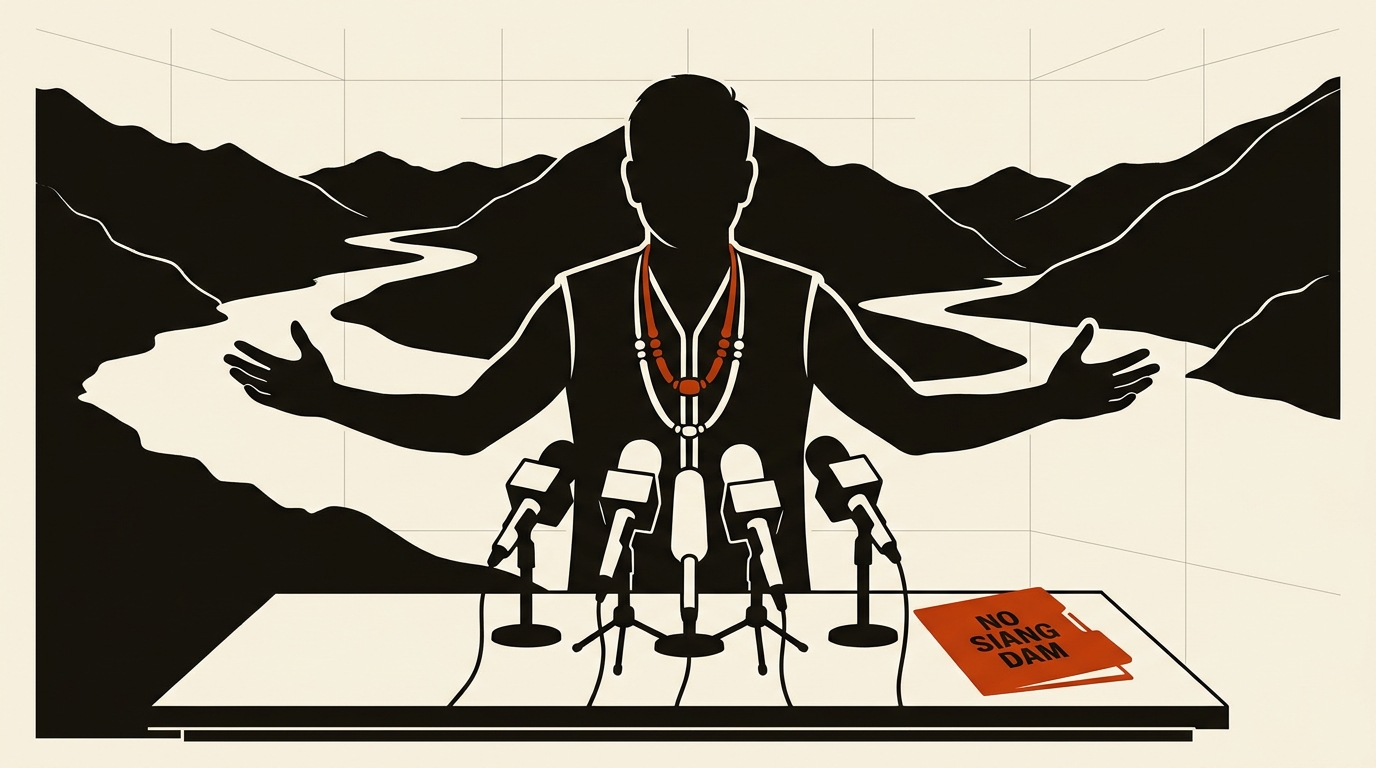
Arunachal Border Villagers Cut Off as Troops Face Inward
A fact-finding team says China has blocked Indian patrol points in Upper Subansiri. The same month, Delhi deployed 23,000 personnel against a protest.
Verdict: true, with context.
Primary source: Satellite images show China advancing into contested India border territory as Xi travels to New Delhi →
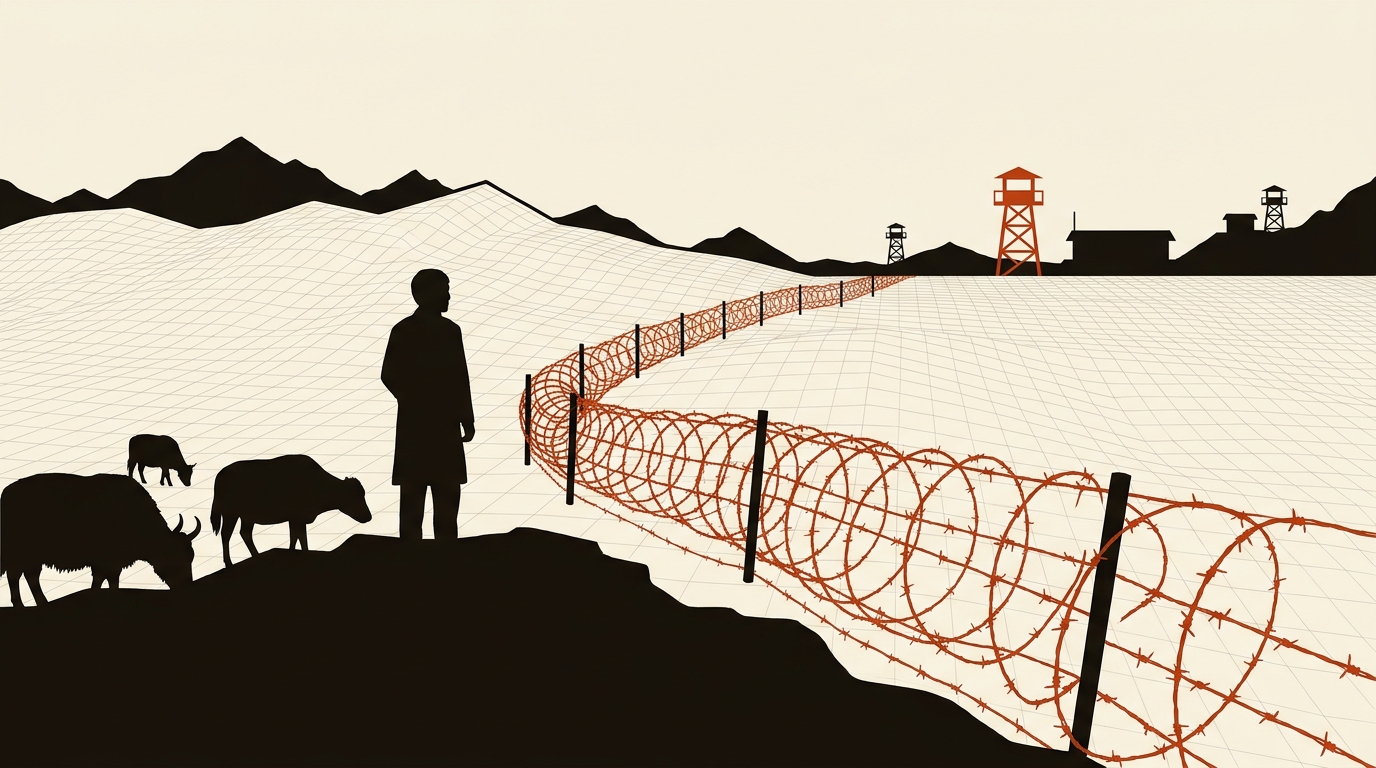
Frontier communities report losing access to ancestral grazing land while the state can muster 23,000 personnel for a single protest in Delhi.
Correction (2026-11-16): An earlier version of this article cited the Ministry of External Affairs, The Hindu national section and The Guardian India section homepages. Every source now points to the specific report, and the body separates what local bodies allege from what satellite imagery and official statements establish.
Short answer: Both halves of the contrast are documented, and the word “annexes” is where the claim overreaches. Local tribal bodies in Upper Subansiri say the PLA has established roads, bridges and camps on ground their communities used for grazing and hunting, and a fact-finding team of regional politicians reported that China has denied Indian patrol points and encroached on land. What is verified is a loss of access reported by named residents and documented in satellite imagery, not a settled transfer of territory. Separately, Delhi deployed 23,000 security personnel for a single protest on October 10. The resources exist. The question is where they are pointed.
1. The grazing lands, in the words of the people losing them
The Independent’s September 12 investigation is the most detailed account. Reporters accessed satellite imagery showing rapid expansion of infrastructure at multiple sites along and near the disputed frontier in Arunachal Pradesh, including new buildings, roads and helipads.
The complaint came from the Nah Welfare Society, a local tribal body representing the Nah Indigenous community, which migrated from Tibet and settled in Upper Subansiri generations ago. In a memorandum to the district commissioner, the society said the PLA had established roads, bridges and military camps at several locations traditionally used by local communities for grazing, hunting and the collection of forest produce. Its words were plain: “The intention and speed of the present activities of the Chinese PLA at Taksing are very alarming. We are losing our land inch by inch day by day.”
Two independent fact-finding groups then travelled to Gelemo and Taksing, villages roughly 15 to 20 kilometres from the border. One was led by Tadak Pakba, president of the All Tagin Students’ Union, with a team of eight gathering accounts from residents, tribal communities and military porters. Between August 11 and 13 they conducted a three-day field investigation and reported Chinese encroachment at several positions normally patrolled by the Indian Army, including remote hunting and yak-grazing grounds.
“Villagers are currently forbidden from accessing these areas, this has caused panic among locals, leading some to move away from the border areas,” Pakba told The Independent. He added that the change was recent: “This is all very recent, happening since June this year.”
Takok Mra, a 38-year-old resident of Gelemo whose family has held the land since the 1962 war, put the personal stake without rhetoric. “I am a true patriot. Give us weapons to save our country and our land.”
2. What the politicians’ fact-finding team found
Al Jazeera reported on August 17 that China had denied the Indian army access to key patrolling points and encroached on land in Arunachal Pradesh, according to a fact-finding team of regional politicians allied with Prime Minister Narendra Modi’s government. The findings concerned Upper Subansiri, the same remote district. The report triggered political outrage in New Delhi, with the opposition criticising the prime minister for silence on alleged Chinese encroachment along several border fronts.
Outlook India reported a separate claim from a tribal body in Upper Subansiri that the PLA had built roads and camps inside Indian territory, occupying traditional Nah grazing, hunting and forest-produce areas.
These are allegations from named local bodies and a political delegation, not an adjudicated boundary ruling. The distinction matters because China claims the whole of Arunachal Pradesh as Zangnan, or Southern Tibet, and the de facto boundary, the McMahon Line, is not legally defined in the areas in question. Srikanth Kondapalli, a professor of China studies at Jawaharlal Nehru University, described the method to The Independent as salami slicing: “First, the Chinese release some yaks and wait for the Indian army’s response. If it’s absent for months, they install a small shed, then convert it into a permanent structure, and when they face no resistance, they build a small army company.”
3. The Xiaokang villages, and the part the claim gets wrong
The Xiaokang programme is real and heavily documented, but it is not the same thing as the grazing land disputes.
The Indian Express reports that China has built 628 Xiaokang, or “well-off”, villages along India’s borders with the Tibet Autonomous Region over more than five years, across the Line of Actual Control including the Ladakh and Arunachal Pradesh sectors. The programme was flagged by Lieutenant General Rajiv Ghai. CSIS ChinaPower has published commercial satellite imagery of what it calls dual-use villages along the disputed border, and Nation Press reports a retired Indian Army commander’s warning that more than 241,000 Tibetans have been enrolled in frontier settlements, about 90 percent of them facing Arunachal Pradesh.
So the two elements of the viral claim belong together geographically but should not be fused. The Xiaokang villages are a settlement and infrastructure programme on the Chinese side of the frontier. The grazing complaints concern PLA activity on specific hunting and yak-grazing grounds in the Taksing-Gelemo area. India’s own answer, the Vibrant Village Programme, has been far less effective. Kondapalli told The Independent it “has not been successful” because it needs a supporting ecosystem.
The honest reading is that the claim is directionally right and legally imprecise. Land is being lost in the sense that communities report being barred from ground they have used for generations. “Annexation” is a legal conclusion that no source here reaches.
4. The other half: 23,000 personnel for one protest
The contrast with Delhi is not an invention. The Hindu reported that before the October 10 Jantar Mantar protest, 45 metro stations were shut, trains were cancelled and 23,000 security personnel were deployed. Frontline reported that CJP leaders were detained, the metro suspended and internet services shut down. Al Jazeera reported that the leaders were released after the crackdown.
The detailed record is in our own reporting on the October 10 crackdown and the October 2 protest in Mumbai. Neither was a trivial gathering, and both were about the electoral roll rather than the border. That is the context the comparison drops.
There is a related Arunachal story with the same shape, where strategic infrastructure is being built over the objections of the people who live there: the Siang dam dispute.
5. The context that makes the comparison fair
The viral version treats this as a choice between two deployments. The actual division of labour does not work that way.
The Line of Actual Control is guarded by the Indian Army and the Indo-Tibetan Border Police. protest policing in Delhi is a matter for the Delhi Police and central paramilitary reserves under the Ministry of Home Affairs. You cannot move a mountain division to Jantar Mantar, and you cannot post a riot squad on a ridge at 16,000 feet. Dispatching officers to a protest does not strip a single rifleman from an eastern post.
What is shared is the budget and the attention. Both forces are funded from the same central exchequer, and the political decision about which one gets prepared, equipped and forward-deployed is a real one. The grievance in the viral post is about priorities, and that is a fair question even when the mechanical comparison is wrong.
There is also a limit on what an external observer can verify. Satellite imagery establishes construction. It does not establish whose side of an undefined line a structure sits on, and the boundary itself is disputed. The residents’ accounts are detailed and named, but they are accounts, and China disputes the premise. That is why the verdict is true with context rather than simply true.
Sources to check yourself
- The Independent, September 12: the Nah Welfare Society memorandum, the Taksing-Gelemo field investigation, the yak-grazing grounds and Kondapalli’s salami-slicing description.
- Al Jazeera, August 17: the regional politicians’ fact-finding report on Upper Subansiri and the political reaction in Delhi.
- CSIS ChinaPower: commercial satellite imagery of the dual-use border villages.
- The Indian Express: the 628 Xiaokang villages and Lieutenant General Ghai’s warning.
- Outlook India: the tribal body’s allegation about roads and camps on Nah grazing land.
- Nation Press: the retired army commander’s account of the settlement programme.
- The Hindu, October 10: 45 metro stations shut, trains cancelled and 23,000 personnel deployed.
- Frontline: the detentions, metro suspension and internet shutdown.
- Al Jazeera, October 10: the release of the detained protest leaders.
Frequently asked questions
Q: Are Indian villagers really losing access to grazing land? A: Named local bodies say so. The Nah Welfare Society says the PLA has built roads, bridges and camps at traditional grazing, hunting and forest-produce sites, and a fact-finding team reported that villagers are forbidden from entering areas they have long used. These are documented allegations, not an adjudicated boundary finding.
Q: What are Xiaokang villages? A: They are Chinese “well-off” border settlements built along the Line of Actual Control. The Indian Express reports 628 of them, including in the Arunachal Pradesh sector. They are a separate programme from the reported PLA activity on specific grazing grounds in Taksing-Gelemo.
Q: How many security personnel were deployed in Delhi? A: The Hindu reported 23,000 personnel for the October 10 Jantar Mantar protest, with 45 metro stations closed and trains cancelled.
Q: Can the same forces do both jobs? A: No. The LAC is guarded by the Indian Army and the ITBP, while Delhi protest policing falls to the Delhi Police and central paramilitary reserve units. The shared question is political priorities and funding, not a direct redeployment.
Reader discussion
Conversation for this story opens with memberships. Until then: found an error? Report it — we correct visibly.