Karjat: 32,490 Trees Marked for Torrent Power
Nearly 1,100 trees were felled before protests halted work on Torrent Power's 3,000-MW pumped-storage project. The record shows 32,490 trees marked across 377 hectares.
Verdict: true, with context.

Clearing hundreds of hectares of dense Sahyadri forest threatens Katkari settlements, fragile water tables, and increases severe landslide risks.
Short answer: The core numbers hold. Reporting by The Economic Times puts the total at 32,490 trees marked for felling for Torrent Power’s 3,000-MW Saidongar-I pumped-storage project in Karjat, Raigad district. The Indian Express, which documented the 377-hectare project area, reported that nearly 1,100 trees had been cut before the operation was halted after protests; The Economic Times put the figure at around 1,800. Around 150 Katkari families who depend on the forest were never recorded in the Forest Rights Act process, so the project was cleared on the basis that no rehabilitation was needed.
Correction (2026-11-14): An earlier version said felling had already cleared all 32,000 trees, used 370 hectares, and described the villages as Saidongar, Kotwal Khalati and Pali. Reporting by The Indian Express and The Economic Times shows 32,490 trees were marked, the project area is 377 hectares, and roughly 1,100 to 1,800 trees had been felled before work stopped. The affected hamlets are Saidongar, Dhak, Pali, Potal, Ambot and Bhaliwadi. The earlier version also cited an unverified estimate of 100,000 trees lost; that figure has been removed.
1. What the ground record shows in Karjat
The chalk marks are still visible on the stumps. Forest officials numbered each tree before cutting it, and The Indian Express found those numbers on the wood at Saidongar hill in November. Felling began on Dussehra morning and was stopped after villagers’ protests drew opposition leaders and activists to Karjat. Nearly 1,100 trees had been felled by then.
The project is the Saidongar-I pumped-storage facility. Torrent Power is building it at a cost of Rs 13,505 crore, with operation targeted for 2029. It needs 377 hectares along the Sahyadri range in Raigad district. Of that, 233 hectares belong to the forest department and 144 hectares fall within six hamlets: Saidongar, Dhak, Pali, Potal, Ambot and Bhaliwadi.
The Economic Times reported that around 1,800 of the 32,490 trees had been cut by the time the row broke out, while The Indian Express put the number at nearly 1,100 when work stopped. Torrent Power says the project sits about 16 kilometres from the Bhimashankar Wildlife Sanctuary and that all components fall outside the sanctuary and its notified eco-sensitive zone.
2. The families the clearance did not count
The slopes are not empty land. Each hamlet is home to 20 to 25 families, roughly 150 in all, most from the Katkari tribal community. They gather firewood and sell it for Rs 150 to 200 a day. They harvest honey, mahua, jamun and guava. The forest is also their pharmacy: neem, gulvel and adulsa are used for fever, respiratory illness and wounds.
The Pej river runs at the foothills and supplies fish and crabs in the monsoon. This year it has largely dried up because of a rainfall deficit, leaving the forest as the main source of income until the rains return. Guards now prevent villagers from carrying away the felled wood.
The Forest Rights Act, 2006, is supposed to settle claims before forest land is handed to a project. Under Section 6, the Gram Sabha initiates the process and forwards claims to a sub-divisional committee. In Pali, forest officials told The Indian Express that the Gram Sabha never submitted records of which families depend on the forest. With no record before it, the department cleared the land on the basis that none existed.
The environmental clearance issued by the Union Ministry of Environment, Forest and Climate Change accordingly states that no rehabilitation of families or villages is envisaged. Sameer Shinde, Range Forest Officer for Karjat, said multiple public hearings were held over 18 months and attended by more than 400 people, but the formal record never arrived. Without it, he said, compensation and rehabilitation cannot be processed.
3. What the ecology report lists
The project area sits in a stretch that the 2011 Western Ghats Ecology Expert Panel, led by ecologist Madhav Gadgil, placed in ESZ 1, the highest-protection category where it recommended no new large dams or major infrastructure. Those recommendations were never implemented, and later drafts narrowed the protected area.
The environmental clearance report lists 26 species in the broader study area under Schedule I of the Wildlife (Protection) Act, 1972. Fourteen are mammals, including the leopard, Indian sloth bear, Indian porcupine, sambar deer, jungle cat and Indian wolf. Six are birds, including the Indian peafowl, osprey, black eagle and white-eyed buzzard. Six are reptiles, including the Asian chameleon, Russell’s viper, Indian cobra and Indian python.
A state forest official told The Indian Express that these were recorded across the wider region surveyed for the clearance, which adjoins the Bhimashankar forest, not necessarily within the 377 hectares being taken. The project earmarks Rs 3.26 crore for a biodiversity and wildlife conservation plan.
The downstream risk is harder to see. A 2018 study by researchers from IIT Bombay and CSIR found that evapotranspiration from Western Ghats forests is a major moisture source for the Cauvery basin. It estimated the forests contribute around 3 mm of rain a day across much of Tamil Nadu in August and September, and that removing the vegetation could raise average surface temperatures in Tamil Nadu by 0.25 degrees Celsius. Co-author Raghu Murtugudde said land-use change can amplify warming at the local level.
4. The politics, the money and the missing link
The dispute has a clear political dimension. Shiv Sena (UBT) leader Aaditya Thackeray visited the site on October 26 and asked why the Sahyadri range was chosen for a Gujarat-based company’s project. Maharashtra Navnirman Sena chief Raj Thackeray visited on October 28. Chief Minister Devendra Fadnavis has defended the project as necessary for energy storage and called the opposition politically motivated.
The financial record is real but does not by itself prove a quid pro quo. Newslaundry reported that Torrent Group donated at least Rs 137 crore to the Bharatiya Janata Party between May 2019 and January 2024, citing Election Commission data. Torrent Power accounted for Rs 76 crore of that total. No reporting reviewed for this article establishes that the Karjat clearance was granted in exchange for those donations, and the company says the project went through a statutory approval process.
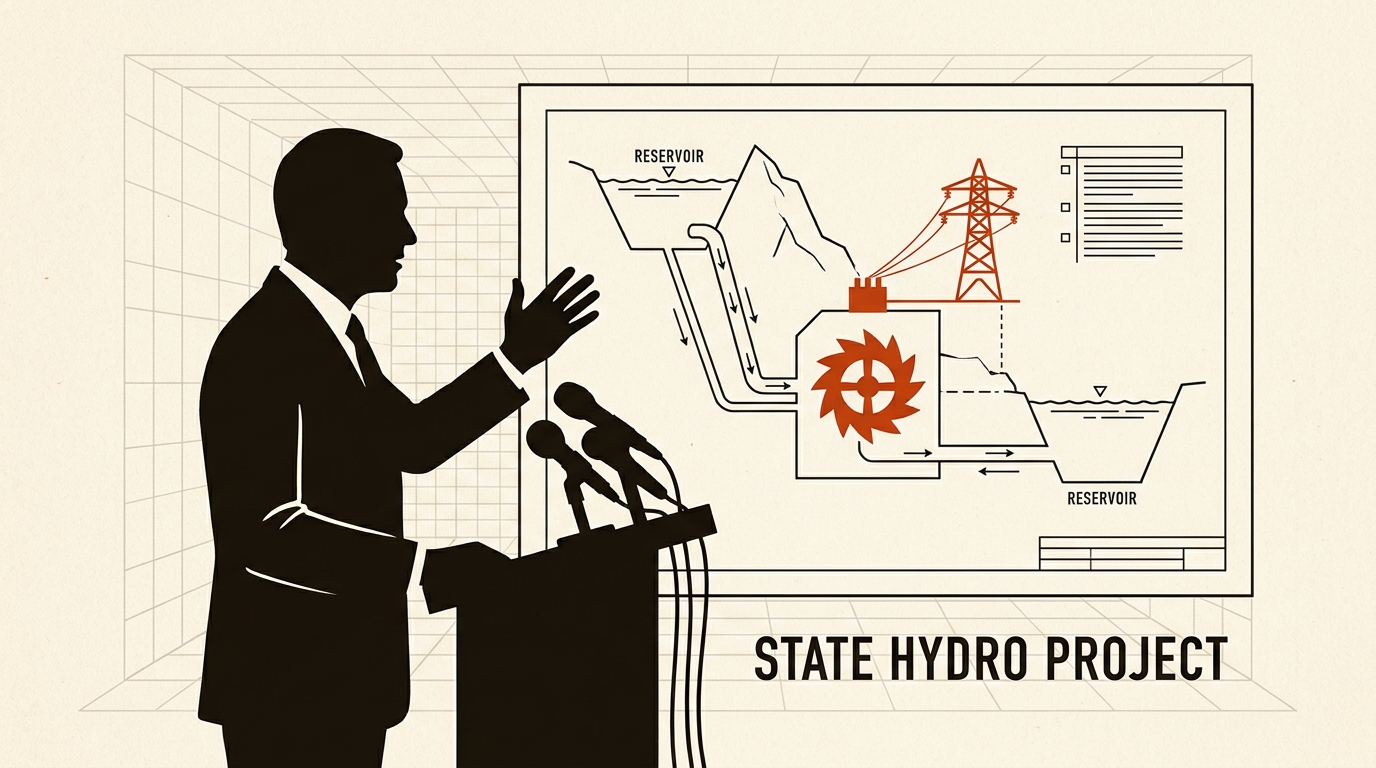
The government’s case rests on grid need. According to NITI Aayog’s India Climate and Energy Dashboard, 74.19 per cent of Maharashtra’s electricity comes from coal-based plants. A 3,000-MW storage facility would equal almost a tenth of the state’s demand and about three-quarters of Mumbai’s. Pumped storage banks surplus solar and wind power by pumping water uphill and releasing it through turbines at peak demand.
Fadnavis has announced a plan to plant 90,000 trees: 30,000 on land provided to the Forest Department and 60,000 in the project area. Torrent says it has transferred 253 hectares in Satara district, about 200 kilometres away, for compensatory afforestation, and that the land already holds an estimated 70,000 trees with another 30,000 to be planted. It also promises a 50-bed hospital for tribal people and 2,000 construction jobs.
5. Why residents fear the monsoon
The deepest local fear is slope failure. The Sahyadri hills are layered basalt with weathered laterite soil, and tree roots bind steep slopes together. Removing mature trees and blasting tunnels changes how water drains.
In July 2023, a hillside collapse at Irshalwadi in Raigad district buried a tribal settlement and killed at least 86 people. In 2014, the village of Malin in Pune district was flattened by a landslide that killed more than 150. Both disasters remain reference points in local opposition to hillside construction, and landslide risks across the region have reinforced those fears.
Engineers quoted by The Indian Express describe pumped storage as a useful grid tool, not a frivolous project. The dispute is about location and process, not whether storage has value. The forest department says the halt is temporary and no decision has been taken on when felling will resume. For the Katkari families in the six hamlets, the question is whether the record that was never filed can still be fixed before the chainsaws return.
The same contest between a strategic infrastructure case and village-level consent is playing out at a much larger scale in the Siang dam dispute.
Sources to check yourself
- The Indian Express: the on-ground investigation, the 1,100 trees felled, the Forest Rights Act gap, the ESZ 1 history and the rainfall study.
- The Economic Times: the 32,490-tree total, the roughly 1,800 trees cut, the 90,000 saplings and the political reaction.
- Newslaundry: the Torrent Group donation record and the project ownership structure.
- Hindustan Times: the forest division’s instruction to transplant rather than cut where possible.
- 2023 Raigad landslide and 2014 Malin landslide: casualty figures for the two disasters residents cite.
Frequently asked questions
Q: How many trees are being cut in Karjat for the Torrent Power project? A: Reporting by The Economic Times puts the total at 32,490 trees marked for felling. The Indian Express reported that nearly 1,100 had been cut before protests halted the operation in late October 2026.
Q: What is the purpose of the Karjat pumped-storage project? A: The Rs 13,505-crore project is designed as a 3,000-MW pumped-storage facility. It pumps water to an upper reservoir when demand is low and releases it through turbines at peak demand, helping balance solar and wind power.
Q: Why are Katkari families and environmentalists protesting? A: Protesters cite the loss of forest access, the failure to record around 150 families under the Forest Rights Act, damage to a wildlife corridor, and landslide risk. The government says the project followed statutory approvals and is needed for grid stability.
Reader discussion
Conversation for this story opens with memberships. Until then: found an error? Report it — we correct visibly.