The 850 Lok Sabha Seats Plan: The Delimitation Math
The Constitution (131st Amendment) Bill, 2026 failed at 298 votes to 230. Here is the arithmetic of the two-thirds threshold and the seat math behind the 850-seat plan.
Primary source: PRS Legislative Research bill tracker for the Constitution (131st Amendment) Bill, 2026 →
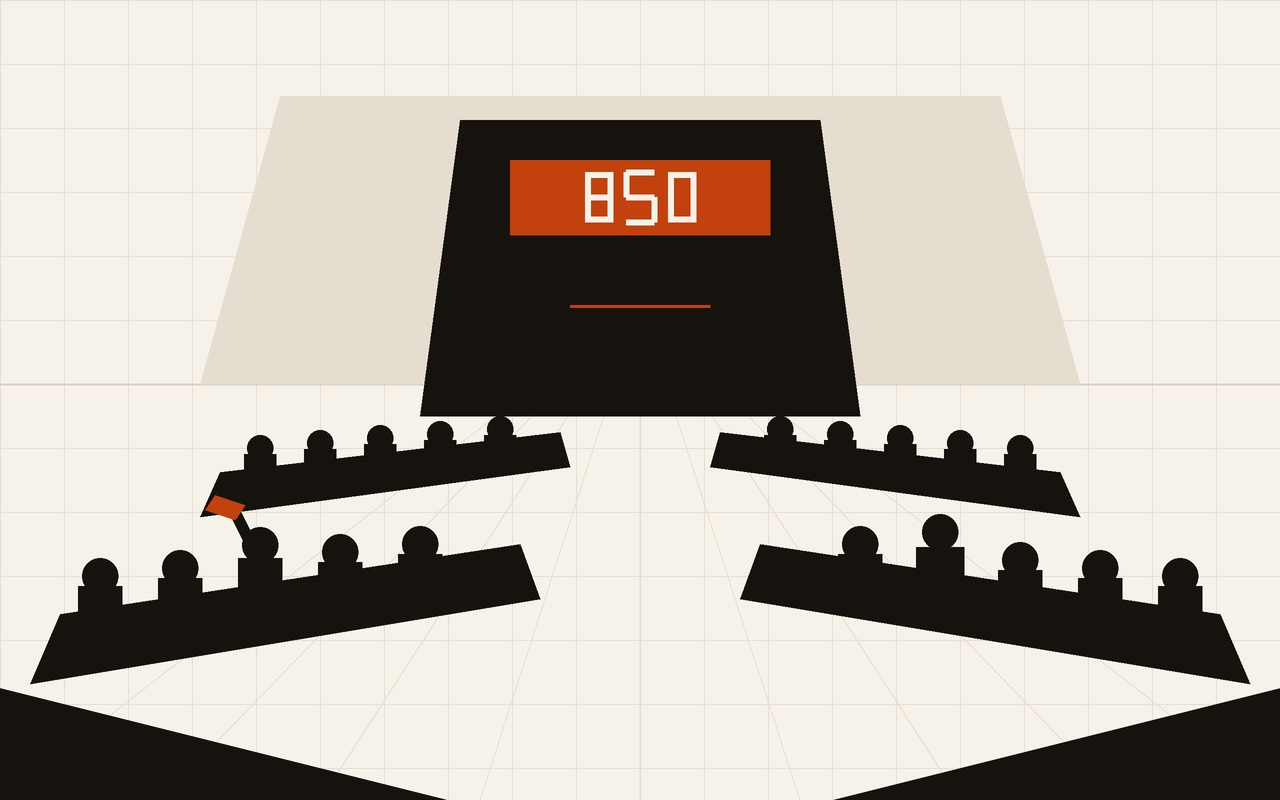
Redrawing constituencies on 2011 census figures would move seats between states for the first time since 1976, and the projected losers and winners are already calculable.
Short answer: The 850-seat Lok Sabha did not fail on the arithmetic of its own design but on the arithmetic of the vote. The Constitution (131st Amendment) Bill, 2026 was negatived in the Lok Sabha on April 17, 2026 with 298 votes in favour and 230 against, and with 528 members voting the two-thirds threshold stood at 352. The companion Delimitation Bill, 2026 and the Union Territories Laws (Amendment) Bill, 2026 were withdrawn with it. The seat math is not in doubt: PRS Legislative Research has published state-by-state projections, and they are the reason the bill died.
1. The threshold that failed, and by how much
Article 368 of the Constitution requires a majority of the total membership of the House and a two-thirds majority of members present and voting for a constitutional amendment. Drishti IAS records the division in the House as 528 members voting, 298 in favour, and a required benchmark of 352. That is 54 votes short.
The bill had been introduced in the Lok Sabha on April 16, 2026 by Arjun Ram Meghwal, the Union Minister of Law and Justice, during a special session that ran from April 16 to April 18, and it was voted down the next day. Wikipedia’s summary of the statement of objects and reasons gives the government’s own reasoning: the next census and the delimitation exercise it triggers “will take considerable time and thus, delay the effective and dedicated participation by women in our (India’s) democratic polity.”
That was the design. The 106th Constitutional Amendment Act of 2023 had already reserved one-third of Lok Sabha and state assembly seats for women, but tied it to the first census after the 2023 Act, and PRS notes the reference date for that census is March 1, 2027. Since the next general election is in 2029, the reservation would not apply to it. The 131st Amendment was the attempt to break that link by operationalising women’s reservation through a delimitation exercise based on the 2011 census instead.
2. What the package actually proposed
PRS tracks the three bills as a single package, all introduced on April 16, 2026.
The Constitution Amendment Bill would have raised the constitutional maximum strength of the Lok Sabha from 550 to 850, with up to 815 seats allocated to states and up to 35 to union territories. It would also have removed the constitutional requirement that seats be reapportioned after every census, leaving Parliament to decide by law when delimitation happens and which census is used. PRS flags the consequence plainly: that decision could be taken by simple majority.
The Delimitation Bill, 2026 would have used the latest published census as on the date the Delimitation Commission is constituted, which implies the 2011 census. It also set out the Commission’s composition: a chairperson who is or has been a Supreme Court judge, the Chief Election Commissioner or an Election Commissioner nominated by him, and the State Election Commissioner of the state concerned, with the central government appointing the chair.
The third bill, on union territories, gives effect to the same provisions for Puducherry, Delhi and Jammu and Kashmir.
The freeze being broken is the thing to hold on to. The 42nd Constitutional Amendment in 1976 froze each state’s seat total on the basis of the 1971 census, originally until the first census after 2000. The 84th Constitutional Amendment in 2001 extended that freeze to the first census after 2026. The bill would have ended it.
3. The seat math, state by state
This is where the bill ran into its opposition, and PRS has done the projection. Holding the total Lok Sabha at its current strength of 543 and reallocating on 2011 census figures, the numbers move sharply.
Tamil Nadu falls from 39 seats to 32. Kerala falls from 20 to 15. Andhra Pradesh falls from 42 to 38, Odisha from 21 to 19, Karnataka from 28 to 27, Punjab from 13 to 12 and Uttarakhand from 5 to 4. Himachal Pradesh falls from 4 to 3. Going the other way, Uttar Pradesh rises from 80 to 89, Bihar from 40 to 46, Rajasthan from 25 to 30, Madhya Pradesh from 29 to 32, Maharashtra from 48 to 50, Gujarat from 26 to 27, Haryana from 10 to 11 and Jharkhand from 14 to 15.
The share percentages tell the same story more compactly. Tamil Nadu’s share drops from 7.18 percent to 5.84 percent while Uttar Pradesh’s climbs from 14.73 percent to 16.24 percent. Reading a projection table is a skill of its own, and our guide on how to read rankings covers the part that matters most here: what the denominator is doing underneath the numbers.
Two details from PRS are worth repeating because they are often left out. First, the shift is not an artefact of the 543-seat total. PRS projects the same direction with a 50 percent expansion to 813 seats, where Tamil Nadu would hold 48, Kerala 22, Uttar Pradesh 133 and Bihar 69. Second, the “no state will lose seats” assurance was not in the legal text. The Carnegie Endowment for International Peace makes that point in its May 2026 analysis, noting that the government repeatedly insisted no state’s share would decline while the bill itself contained no such guarantee.
4. The two knock-on effects nobody voted on
An 850-member Lok Sabha is not only a bigger Lok Sabha. PRS lists two consequences that follow automatically from the arithmetic.
The first is the balance between the Houses. Article 80 caps the Rajya Sabha at 250 members and the 131st Amendment left that untouched, so the ratio of Lok Sabha to Rajya Sabha seats shifts from 2.2 to 1 to 3.3 to 1. That reduces the relative weight of Rajya Sabha members in the election of the President and the Vice-President, and it increases the Lok Sabha’s leverage in a joint sitting.
The second is the size of the Council of Ministers. Article 75 caps the Union council at 15 percent of Lok Sabha membership. PRS calculates that a 50 percent expansion from 543 to 815 would raise that ceiling from 81 to 122.
5. Why the opposition objected, in numbers
The Carnegie Endowment measures the malapportionment using the Samuels-Snyder index, the standard political science measure of how many seats sit in the “wrong” state. It finds roughly 8 percent of Lok Sabha representation misallocated across states and union territories, which is about 44 of the chamber’s 543 seats. Uttar Pradesh and Bihar are the two most underrepresented states, each falling short of its population share by roughly 2 percent. Tamil Nadu and Kerala are the two most overrepresented, exceeding their population shares by about 2 percent and 1 percent.
That is the dispute in one line. A vote cast in a southern state currently carries more weight than a vote cast in a northern one, and the bill would have corrected it. The southern objection is not a defence of the current allocation; it is a defence of a different balance.
Carnegie also records that the five major southern states (Andhra Pradesh, Karnataka, Kerala, Tamil Nadu and Telangana) would lose 27 seats collectively on 2011 census figures, and notes the awkwardness in the government’s own dating, since the 2011 numbers would already be fifteen years old by the 2029 election. On the eve of the debate Tamil Nadu’s chief minister called the proposed delimitation a “massive historic injustice” and said the ruling party “was playing with fire”; Kerala’s chief minister had earlier called it a “sword of Damocles” hanging over the southern states.
Carnegie also puts a number on an alternative. Expanding the Lok Sabha just enough that no state loses seats, while underrepresented states gain enough to bring their representation into line with population share, using the Webster method and 2026 population projections, would need roughly 775 members. That is a different bill, but it is the shape of the compromise the arithmetic permits.
6. The fight is back on the table
The package is not dead, only paused. On October 16, 2026, Congress president and Rajya Sabha Leader of the Opposition Mallikarjun Kharge wrote to Prime Minister Narendra Modi asking for an all-party meeting before any fresh delimitation bill is introduced, and flagging that 64 days had passed since the Monsoon Session adjourned sine die on August 13 without either House being prorogued. The Hindu reported the appeal as a warning against trying to “bulldoze” a far-reaching amendment.
Parliamentary Affairs Minister Kiren Rijiju replied on October 19. The South First, which published the letter, records that he listed consultations with the DMK, Samajwadi Party, YSR Congress Party, Nationalist Congress Party, Shiv Sena (UBT), AIMIM and the Biju Janata Dal, and that he cited his own letters to Kharge dated March 16, March 26 and April 12, 2026, plus a personal discussion and a meeting with Rahul Gandhi during the Monsoon Session. His conclusion was that Congress did not give dates for discussion, so the outreach widened to other parties.
On the prorogation point, Rijiju’s letter is the more interesting document. The Constitution sets no deadline between a sine die adjournment and prorogation, and he cited instances of Houses sitting unprorogued for up to 87 days. The 2008 case he gave: the Lok Sabha sat for two days on July 21 and 22 for a confidence motion, stayed unprorogued, reconvened on October 17, adjourned on October 24 and met again on December 10. He also cited 1987 (76 days), 1989 (54 days), 2006 (49 days) and 2013 (49 days). Kharge’s camp did not accept the point, and the Hindustan Times reported his response as a complaint that the minister had answered the Prime Minister’s letter rather than the Opposition.
That exchange matters because the bills are expected to be reintroduced. The South First reported them as due to return when Parliament reconvenes.
The other piece of parliamentary arithmetic worth watching is the electoral roll itself. The Special Intensive Revision of electoral rolls is being litigated at the top court, and the Supreme Court’s handling of the CEC hearing turns on the same 2029 election calendar that the women’s reservation timetable depends on. And the Opposition’s use of the courts in the meantime is not new ground: the Rahul Gandhi defamation acquittal in Sultanpur is part of the same political cycle.
Sources to check yourself
- PRS Legislative Research bill tracker: the introduced and negatived dates, the four key features, the 550 to 850 change with 815 from states and 35 from union territories, the Rajya Sabha ratio, the Council of Ministers ceiling and the full state-by-state projection table.
- PRS on the Delimitation Bill, 2026: the census rule and the Delimitation Commission composition.
- Drishti IAS on the defeat: the House strength of 528, the 352 benchmark and the withdrawal of the two companion bills.
- Carnegie Endowment, May 2026: the Samuels-Snyder malapportionment figure, the southern states’ combined seat loss, the 775-seat alternative and the chief ministers’ reactions.
- ABC Live, April 17, 2026: why the government stopped with the delimitation measure.
- The New Indian Express, October 16: the date of Kharge’s fourth letter and the 64-day prorogation question.
- The South First, October 19: the text of Rijiju’s reply, the list of parties consulted and the historical prorogation precedents.
- Hindustan Times: the Opposition’s response to the reply.
- Wikipedia on the bill: the vote tally and the statement of objects and reasons.
Frequently asked questions
Q: Why did the bill fail if 298 members voted for it? A: A constitutional amendment needs a two-thirds majority of members present and voting. With 528 members voting, the threshold was 352 votes. The 298 in favour fell 54 short.
Q: Did the government promise that no state would lose seats? A: It did so publicly, and the Carnegie Endowment for International Peace notes that the bill’s legal text contained no such guarantee. PRS projections show Tamil Nadu falling from 39 seats to 32 and Kerala from 20 to 15 on 2011 census figures with the House held at 543 seats.
Q: Is women’s reservation now delayed? A: It is still tied to a census. PRS notes the 106th Amendment ties the one-third reservation to the first census after the 2023 Act, with a reference date of March 1, 2027, which is too late for the 2029 general election. That timing problem is what the 131st Amendment was designed to solve.
Q: What happens to the bill now? A: The 131st Amendment was negatived on April 17, 2026, and the Delimitation Bill and Union Territories Laws (Amendment) Bill were withdrawn. The South First reported them as expected to be reintroduced when Parliament reconvenes, and Kharge asked for an all-party meeting before any fresh bill.
Reader discussion
Conversation for this story opens with memberships. Until then: found an error? Report it — we correct visibly.