JWST Finds the Oldest Fast Radio Burst Yet
Webb traced FRB 20240304B to a dwarf galaxy at redshift 2.148, 3 billion years after the Big Bang. The host favours magnetars over mergers, but does not prove it.
Verdict: misleading.
Primary source: NASA Webb mission release, October 8, 2026 →
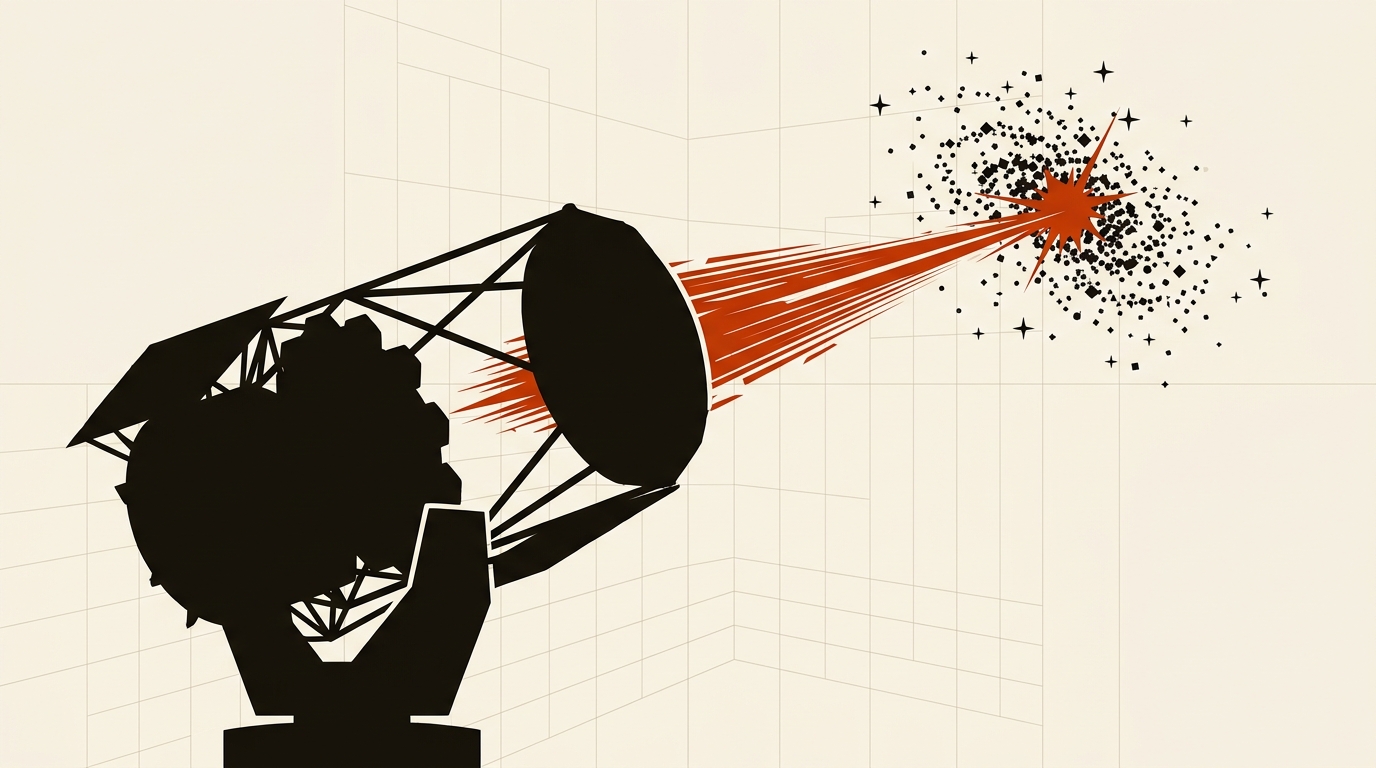
Fast radio bursts have no confirmed cause. Finding one in a galaxy that was still making stars three billion years after the Big Bang narrows the field to young neutron stars.
Short answer: Webb has done something remarkable, and the popular summary of it overshoots. The telescope located the host galaxy of FRB 20240304B, the most distant fast radio burst yet detected, and measured its redshift at 2.148, which places the event roughly 3 billion years after the Big Bang. The host is a small dwarf galaxy that is still forming stars, and that favours the magnetar explanation over the neutron star merger one. The lead author says the work suggests it is “very unlikely that this FRB was produced by a merger”. That is a strong hint, not a proof, and the difference matters.
1. How the burst was caught, and why it was so hard to place
Fast radio bursts were first discovered in 2007. NASA’s release describes them as enigmatic, millisecond-long flashes of radio emission from the distant universe, and notes that most are seen once and never again.
This one was caught on March 4, 2024, by the MeerTRAP team using the MeerKAT telescope in South Africa, which is why it carries the designation FRB 20240304B. The radio data suggested it was extremely distant, possibly the most distant ever seen. Confirming that required locating the host galaxy, and the radio data gave the position with great precision.
Here is where the ground-based work ran out. NASA’s release states that although the team knew the location of the FRB very precisely, the world’s largest ground-based telescopes could not see any galaxy at that spot in the sky. So they turned to Webb.
2. What Webb actually measured
Two instruments did two separate jobs, and the separation is what makes the result firm.
Webb’s NIRCam, the Near-Infrared Camera, detected a galaxy at the right location. Webb’s NIRSpec, the Near-Infrared Spectrograph, then provided a precise measurement of that galaxy’s redshift: 2.148. That corresponds to a time just 3 billion years after the Big Bang, in a universe that formed about 13.8 billion years ago, as the Smithsonian’s account of the result notes.
The Guardian described the flash as more than 10 billion years old and said it travelled through approximately 80 percent of cosmic history. Space.com reported that the new burst more than doubles the previous record.
The Space Telescope Science Institute put the operational point plainly: only the James Webb Space Telescope was able to detect and characterize the host galaxy, determining both its distance and its size. That is the sentence that explains why a result like this took Webb rather than the ground.
3. The surprise in the host galaxy
The expectation was wrong, and the team says so.
NASA’s release reports that the vast majority of FRBs detected to date occurred billions of years later in cosmic history. It also reports that most FRB host galaxies are massive star-forming galaxies, while the galaxy found here was 1,000 times less massive than expected. The University of California, Santa Cruz, whose team members were involved, described the host as a galaxy far smaller and younger than expected, and noted it was actively forming stars.
Manisha Caleb of the University of Sydney, lead author on the study published in Science, put it plainly. “We thought it would be a big, nicely formed galaxy with lots of stars, and instead it was a little dwarf galaxy, although it was actively forming stars.” She added that the host sticks out in the whole galaxy sample.
4. Why that favours a magnetar
Two theories were already in play, and the host galaxy discriminates between them.
The first proposes that an FRB originates from the merger of two neutron stars. The process of orbiting neutron stars gradually approaching closer and closer until they collide is expected to take billions of years, so FRBs would be expected to be associated with older galaxies containing more evolved stellar populations.
The second proposes that an FRB can originate from a single, young, highly magnetic neutron star known as a magnetar, through a mechanism like starquakes. In that case, once a massive star explodes as a supernova and leaves behind a magnetar, an FRB might occur relatively quickly with no large time delay, and FRBs would also be expected to be found in younger galaxies, like the host of FRB 20240304B.
A three-billion-year-old galaxy that is still forming stars fits the second theory and strains the first. NASA’s release quotes Caleb directly: “Our work suggests that it’s very unlikely that this FRB was produced by a merger.” The Space Telescope Science Institute release states that the result indicates FRBs likely are caused by young neutron stars known as magnetars.
5. Why “proves” is the wrong word
The popular version of this story says magnetars are confirmed as the source of fast radio bursts. The record does not say that.
The study is one burst. Manisha Caleb is quoted in NASA’s release making the point that this is what makes the bursts interesting in the first place: “What makes fast radio bursts interesting is that we don’t know what generates them. We have theories for what objects produce them, but we don’t have conclusive proof.”
What the record supports is narrower and still worth having. A burst from a galaxy three billion years old, in a dwarf that is still forming stars, is difficult to explain if the usual engine is a neutron star merger, because mergers are slow. It is consistent with an engine that can fire quickly, and a magnetar is the standard candidate for that.
That is a strong clue with a mechanism attached. It is not a demonstration. The Universe is not obliged to confirm a theory on the strength of one event, and the STScI release itself is careful to say the result “suggests” and “indicates” rather than proving.
For a wider look at how a single measurement gets read as a conclusion, our guide to reading rankings applies, and our piece on NavIC and satellite positioning covers the same discipline in a different field.
Sources to check yourself
- NASA Science, October 8: the MeerTRAP detection, the redshift of 2.148, the 1,000 times less massive host, both competing theories and Caleb’s quotes.
- Space Telescope Science Institute: why only Webb could characterise the host galaxy and the magnetar reading.
- The Guardian, October 9: the age of the flash and the 80 percent of cosmic history travelled.
- UC Santa Cruz: the host described as far smaller and younger than expected.
- Space.com: the doubling of the previous record.
- Smithsonian Magazine: the age of the universe and the travel time of the signal.
Frequently asked questions
Q: What did Webb actually measure? A: Two things, with two instruments. NIRCam detected a galaxy at the burst’s position, and NIRSpec measured its redshift at 2.148, which corresponds to about 3 billion years after the Big Bang.
Q: How old is the burst? A: The signal travelled more than 11 billion years to reach Earth, through roughly 80 percent of cosmic history, according to The Guardian.
Q: Does this settle the magnetar question? A: No. The lead author says the work suggests it is very unlikely the burst came from a merger, and the Space Telescope Science Institute says FRBs likely are caused by magnetars. One burst in one dwarf galaxy is a strong clue, not conclusive proof, and the researchers say so themselves.
Reader discussion
Conversation for this story opens with memberships. Until then: found an error? Report it — we correct visibly.