Why Karnataka's Sugarcane Farmers Blocked NH-48
Growers blocked the Pune-Bengaluru highway and other roads on October 13, 2026, after Delhi talks failed. Their price demands were specific, and the government's reply was specific too.
Verdict: misleading.
The price gap between what a grower is paid and what the cane costs to raise is a statutory formula question, and the blockade is a bargaining method with a specific target list.
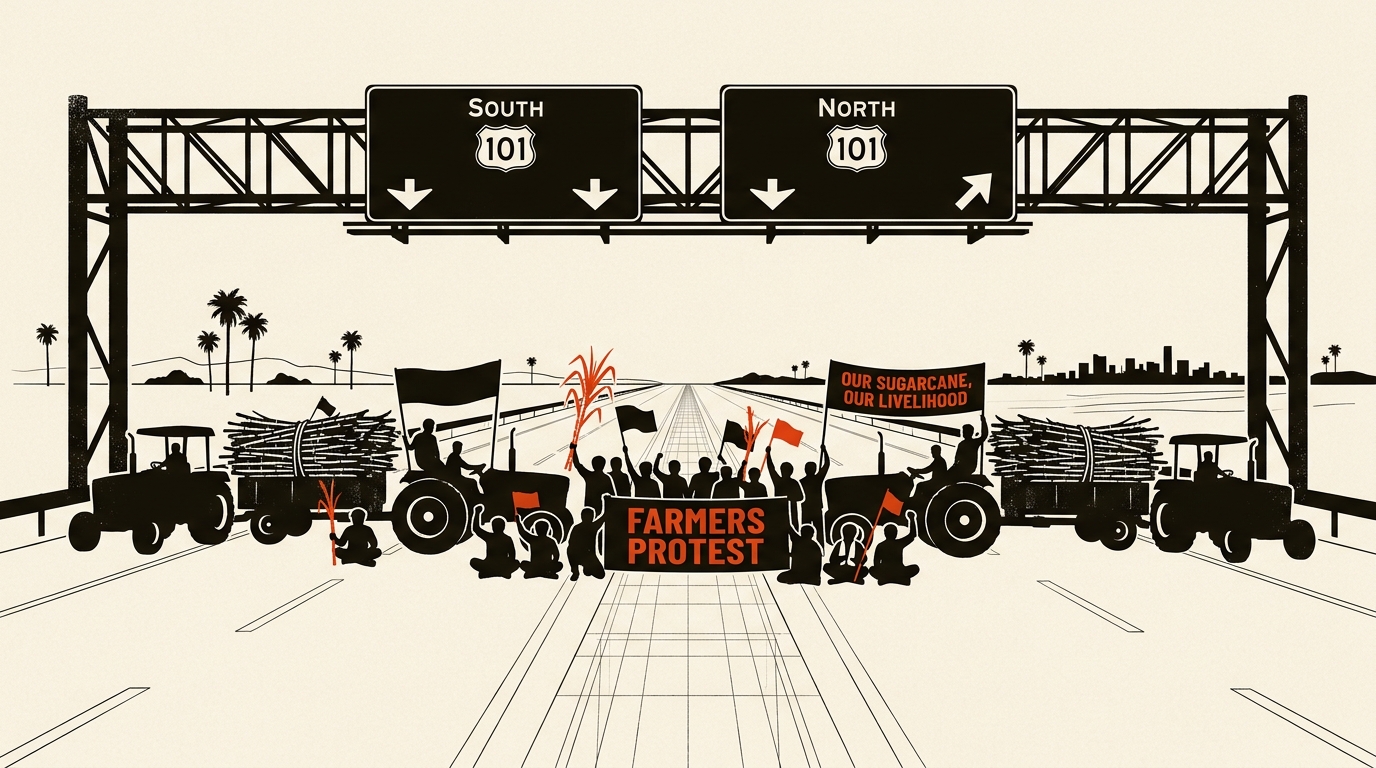
Short answer: The blockade happened, and it was announced. It was also narrower than the viral claim and its demands were specific rather than a general cry about prices. On Tuesday, October 13, 2026, sugarcane growers under the Karnataka Rajya Raitha Sangha and Hasiru Sene blocked National Highway 48 at the Hirebagewadi and Hattaragi toll plazas in Belagavi district, and other highways in Bagalkot, Vijayapura and Dharwad. Their published demands were a sugar MSP of ₹60 per kilogram, a cane FRP of ₹5,500 per tonne, government-supervised weighing, more ethanol purchases and differential pricing for industrial buyers. They also want the resignation of Union Food Minister Pralhad Joshi. Police had been deployed at the toll plazas in advance, and the New Indian Express reports alternative arrangements for vehicles coming from Maharashtra through Belagavi.
Correction (2026-11-15): This article previously cited the homepages of The Hindu, the Deccan Herald and the Economic Times, and its title was a 120-character run-on. It now cites four specific reports. Two figures were wrong and have been corrected against The Hindu’s account of the protest: the sugar MSP demand was ₹60 per kilogram, not ₹160, and the FRP demand was ₹5,500 per tonne, not ₹15,500. The three-corridor diversion table has been removed because no source in the record publishes those routes, and the claim’s “without notice” wording has been corrected to match what the reporting shows.
1. What happened on October 13
The Hindu reported from Belagavi that sugarcane farmers in Karnataka began a protest for higher prices by blocking the Pune-Bengaluru National Highway at Hirebagevadi and Hattaragi in the district on Tuesday, October 13.
The New Indian Express, writing the same night, described hundreds of farmers gathering at the Hattargi toll plaza in Hukkeri taluk and blocking the highway, with the agitation spreading to Hirebagewadi and Kugnoli and to Bagalkot, Vijayapura and Hubballi-Dharwad. The Deccan Chronicle reported the same day that protests were reported from Belagavi, Bagalkot, Vijayapura and Dharwad, disrupting traffic on the Pune-Bengaluru route and National Highway 50 near Nidagundi.
The Deccan Chronicle recorded what happened on the road itself: some protesters lay down in front of vehicles to prevent traffic movement. In Bagalkot, farmers blocked the Raichur-Solapur National Highway near Govinda Patti. In Vijayapura, Hasiru Sene blocked National Highway 50 on the outskirts of Nidagundi, disrupting traffic between Vijayapura and Bengaluru. Police held discussions with the protesters, but the farmers insisted the blockade would continue until their demands were met.
The Hindu’s account of the atmosphere at the toll plaza is the part that travelled: some farmers performed Urulu Seve by rolling on the road, others carried whips and brooms and shouted slogans for unity of farmers against the Union government, and a protest tent beside the highway served water, tea and rotti-bhaji to people who had travelled from far-off places. Bullock carts and tractors were parked at the plaza, and police deployment at both toll plazas was increased.
2. The demands, with the figures the protesters published
The Hindu lists them. Revising the Minimum Support Price for sugar to ₹60 per kilogram, increasing the Fair and Remunerative Price to ₹5,500 per tonne of sugarcane, transparency in weighing and recovery assessment in factories, increased buying of ethanol produced in Karnataka from sugarcane and maize, and differential pricing of sugar for domestic and industrial consumers.
The Deccan Chronicle adds the structural demand: a law mandating that public, cooperative and private sugar factories treat farmers as shareholders and share profits from sugar, molasses, ethanol, co-generated power, oxygen, bio-fertiliser and press mud, along with government-supervised computerised weighing scales and monitoring, and a statewide sugarcane schedule.
The Deccan Chronicle also records what the farmers had already asked for before the blockade. They have been seeking an increase in the Minimum Support Price of sugar, determination of the Fair and Remunerative Price, and implementation of the Swaminathan Commission recommendations, the report of the National Commission on Farmers set up in 2004 and chaired by M S Swaminathan.
One number in circulation needs care. The Hindu’s related coverage records a separate demand of FRP of ₹4,500 from sugarcane growers before this protest, which is a different ask from the ₹5,500 figure the protesters put forward on October 13.
3. Why the blockade happened on that day
The trigger was a meeting that failed. The New Indian Express reports that the protests followed the failure of a meeting between farmer representatives and Union ministers in New Delhi on Monday, October 12, and that farmer organisations had called for an intensified statewide agitation on Tuesday, warning they would not withdraw until their demands were met.
The Deccan Herald’s headline summary is the same in one line: protests at two toll plazas after talks with Joshi fail.
Union Food Minister Pralhad Joshi appealed to the farmers on Monday to withdraw their agitation, assuring them the Centre would address their concerns. The Deccan Chronicle quotes him: “The Government of India, the Modi government, is with you. This cannot be done by one or two ministries alone; several ministries are involved. State governments also have a role to play — all state governments.” He said he and Union Agriculture Minister Shivraj Singh Chouhan had heard the farmers’ grievances and that a committee would be constituted to examine the issues. He also said that before determining prices, the government officially obtains information from the state governments.
One demand is political rather than economic, and The Hindu reports it plainly: the resignation of Pralhad Joshi for inviting the farmers to New Delhi for a meeting and failing to listen to their grievances.
4. What the state said, and what happened next
The New Indian Express reports that Karnataka is working towards a more scientific and transparent system for fair returns to sugarcane farmers, with focus on cane weight, recovery, harvesting period and payment practices. Sugar and Textiles Minister Rudrappa Lamani said the state would conduct a scientific study on the optimal harvesting period and sugar recovery levels across Karnataka’s sugarcane-growing regions and place its findings before the joint committee proposed by the Centre. He said the state had taken seriously complaints from farmers about discrepancies in cane weighing at sugar factories.
The New Indian Express also reported that in Koppal, two women farmers allegedly attempted suicide during a highway blockade staged near the Hitnal toll gate, demanding implementation of the Swaminathan Commission report.
Traffic was affected beyond the protest sites. The New Indian Express reported that police made alternative arrangements for vehicles arriving from Maharashtra through Belagavi, and that the Karnataka High Court later directed officials to ensure the safety of Hubballi residents amid the protests.
5. What the record does not settle
Two things are worth flagging because the viral version of this story fills them in.
The first is the route advice. The earlier version of this article published three named diversion corridors with a routing table for light passenger vehicles, intercity traffic and heavy freight. None of the four sources used here publishes those routes. What the New Indian Express confirms is narrower: that police made alternative arrangements for vehicles arriving from Maharashtra through Belagavi. Any specific diversion advice should come from a traffic advisory on the day.
The second is the cause. The blockade was organised by named farmer organisations, not spontaneous, and it followed a failed ministerial meeting on October 12. The Hindu’s related coverage records a prior threat of a highway blockade from October 13, so “without notice” does not match the record.
6. The verdict: misleading, with the context that the protest was real and announced
The claim is half right. The highway was blocked, the disruption was real, and the price demands were the reason. The part that fails is “without notice”. The protest had a date, an organiser and a demand list, the state had deployed police at the toll plazas before the blockade began, and traffic authorities had made alternative arrangements for vehicles crossing from Maharashtra.
The context that matters is what the protest was trying to buy. This was not a week of spontaneity. It was a bargaining action timed for the start of the crushing season, with a list that runs from two price figures to a demand for farmers to be treated as shareholders in the mills that buy their cane. The New Indian Express reporting that the state is preparing a scientific study on harvesting periods and recovery levels for the committee the Centre has promised shows where the negotiation was actually heading.
For a parallel look at how a statutory price formula collides with ground-level costs, see our Pune water cut report, and for how to read an official index when the headline is a rally, our guide to rankings applies.
Sources to check yourself
- The Hindu, October 13: the blockade locations, the full demand list with the ₹60 per kg and ₹5,500 per tonne figures, the by-products profit-sharing demand and the call for the minister’s resignation.
- Deccan Herald, October 13: the two toll plazas, the organising banners and the failure of the talks with the minister.
- Deccan Chronicle, October 13: the districts hit, the Bagalkot and Nidagundi blockades, the Swaminathan Commission demand and Pralhad Joshi’s remarks.
- The New Indian Express, October 14: the failed Monday meeting, the statewide spread, the Koppal protest, the traffic arrangements and the state’s proposed study.
Frequently asked questions
Q: What exactly were the farmers demanding? A: The Hindu lists a sugar MSP of ₹60 per kilogram, a cane FRP of ₹5,500 per tonne, transparency in weighing and recovery assessment, more ethanol purchases from Karnataka cane and maize, and differential pricing for domestic and industrial buyers. The Deccan Chronicle adds a law making farmers shareholders in the mills and sharing by-product profits.
Q: Why did they block the road on October 13? A: Because the Monday meeting in New Delhi with Union ministers failed, after which farmer organisations called an intensified statewide agitation for the Tuesday, according to the New Indian Express.
Q: Was the protest without notice? A: No. The Hindu’s related coverage records a prior threat of a highway blockade from October 13, and The Hindu reports that police deployment at both toll plazas was increased.
Q: What is the state government doing about it? A: The New Indian Express reports that Sugar and Textiles Minister Rudrappa Lamani said Karnataka will study the optimal harvesting period and recovery levels across its sugarcane regions and put the findings before the joint committee the Centre has proposed.
Reader discussion
Conversation for this story opens with memberships. Until then: found an error? Report it — we correct visibly.